|

Symposium Papers
'Over a Herd of Cattle': The Wright Brothers and the Pursuit of Flight
at Huffman Prairie Flying Field
Elizabeth Fraterrigo
Loyola University History Department
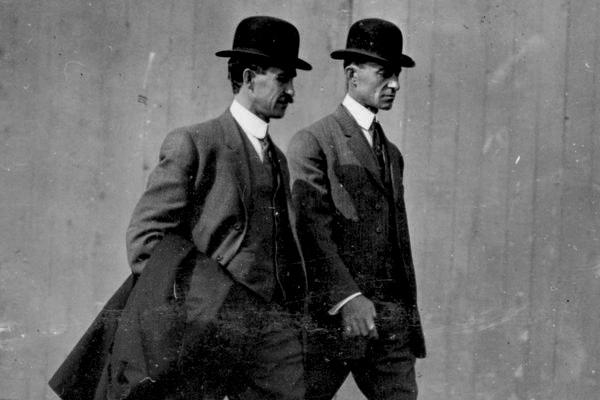
Huffman Prairie Flying Field is a National Historic Landmark, the site where
the Wright brothers, on the heels of their successful first flights at
Kitty Hawk, North Carolina in December 1903, perfected their invention
of a controlled, powered heavier-than-air machine. When I first began
contemplating this presentation, I hoped to come up with a title that
would convey the significance of the events that took place there, as
the Wright brothers, through a series of unique experiments at the flying
field in 1904 and 1905 brought aviation to the world and changed the course
of human history.
Then I started thinking about the Wright brothers' journals and correspondence in which
they recorded their daily advances and setbacks in a quest to build a practical airplane and
learn to fly. Their written observations tell a remarkable story of trial and error, of
ingenuity, perseverance, and ultimately human achievement. And, yet, in the rather prosaic
fashion in which Wilbur and Orville noted their daily progress at the eighty-four acre
cow-pasture-turned-airfield, we are also able to glimpse Huffman Prairie Flying Field as
they did. Not as the National Landmark we know today, but as the far from ideal practice
ground that offered the Wright brothers some conveniences, like a location near an interurban
railway stop, that seemed to make up for the trouble of having to chase away cows and
horses each time they attempted a flight. Simply put, Huffman Prairie Flying Field
was an ordinary place where extraordinary things happened.
Prior to 1904, farmers in the neighboring fields would scarcely have
expected this ordinary cow pasture to be commemorated someday as a site
of national importance. Several features, however, are worth noting for
the role they played in bringing the Wright brothers here to continue
their work. First, the flying field was situated within a large patch
of tallgrass prairie known as Huffman's Prairie.
1Many
people interested in the study of botany were drawn here throughout the
mid to late 1800s. In fact, it may have been the popularity of Huffman
Prairie as a site for collecting and identifying plant specimens that
first brought Orville Wright to this location. His high school science
teacher, William Werthner, brought students to the prairie for their botany
lessons.
The topography and terrain of the flying field is also worth considering.
An 1802 land survey had identified it as "wet, boggy prairie," and its soil offered
poor drainage. A little more than a century later, when the Wright brothers first
traveled to Huffman Prairie to scout a location, they found much of the land surrounding
their eventual flying field under cultivation. It is likely that because the field had such
poor drainage that is was used only as a pasture, making it a viable site for the Wright
brothers' work.
Finally, the situation of the flying field along a longstanding transportation
route also merits our attention. The Dayton-Springfield Pike formed the northwestern
boundary of the flying field. In the late nineteenth century, this road, one of the
earliest in the area, provided a practical route for the building of an electric
inter-city traction line. Passenger service on the new Dayton, Springfield & Urbana
line, which ran parallel to the Dayton-Springfield Pike, began in February 1900 and made
a stop at Simms Station, just fifty yards or so from Huffman Prairie. To the Wright
brothers, the nearby interurban stop made this cow pasture an attractive place to
continue their flying experiments. In contrast to the long trips to their camp at
Kitty Hawk, the flying field could be reached by trolley from downtown Dayton in about
twenty minutes.
The Wright Brothers' Experiments of 1904
Figure 1 Wright Brothers with 1904 Flyer in Front
of Hangar
In spring 1904, after receiving permission from Torrence Huffman to use
his field, the brothers cleared it of tall vegetation and constructed
a small wooden shed, placing it in a far corner of the pasture for privacy.
Wilbur and Orville spent the month of April working at the flying field,
assembling a new airplane from parts constructed at their bicycle shop.
Their first airplane had been destroyed after their fourth flight at Kitty
Hawk, when a gust of wind had sent it tumbling out of control along the
beach. The Wright brothers had their new machine, a slightly modified
version of the Kitty Hawk flyer, completed by late May. They were now
ready to put it, as well as their new practice grounds, to the test.
The Wright brothers quickly found that their new experimental station, as they called it,
was far from ideal. Wilbur provided a good description of the new setting to the brothers'
friend, Octave Chanute. A renowned civil engineer and respected authority on aeronautics,
Chanute had designed and tested gliders on the sandy dunes along the Lake Michigan shore.2
In a letter written in June 1904, Wilbur outlined for Chanute the many challenges they
faced just trying to get their airplane off the ground. Among their biggest problems
were the lack of wind and space, both of which had been in abundance at Kitty Hawk.
"We are in a large meadow of about 100 acres," Wilbur wrote. "It is skirted on the west
and north by trees. This not only shuts off the wind somewhat but also probably gives a
slight downtrend." 3
Comparing the present conditions to their Kitty Hawk camp, Wilbur
explained, "We must learn to accommodate ourselves to circumstances. At Kitty Hawk we
had unlimited space and wind enough to make starting easy with a short track. If the
wind was very light we could utilize the hills if necessary in getting the initial velocity.
Here we must depend on a long track, and light winds or even dead calms." 4
Adding to the challenge was the field's strange, irregular surface. Wilbur described
the ground as "an old swamp…filled with grassy hummocks some six inches high so that it
resembles a prairie-dog town." This made laying the starting track slow work. Wilbur
recounted their troubles to Chanute: "While we are getting ready the favorable opportunities
slip away, and we are usually up against a rainstorm, a dead calm, or a wind blowing at
right angles to the track." Too often the brothers found that just as they finished
staking it in place, they would have to take up and move the track to meet the shifting winds.
Making matters worse, they had promised Torrence Huffman not to harm the animals kept at
the field. "In addition to cattle," Wilbur told Chanute, "there have been a dozen or
more horses in the pasture and as it is surrounded by barbwire fencing we have been at
much trouble to get them safely away before making trials." Chanute advised with humor:
"I hope that you will use great caution in your experiments and will not run into a cow."
Such conditions prevented them from making as many starts as they hoped. "We are a little
rusty," Wilbur admitted. He expressed confidence though, that "with a little more track
and a little more practice" the brothers would "see what the machine can really do in the
way of flying."5
For months, they succeeded in flying only very short distances-a few hundred
feet at best-staying in the air for just seconds each time. By August, they had yet to match
the longest flight made at Kitty Hawk, and in fact, had made only thirteen trials. Wilbur
told Chanute, "It is evident that we will have to build a starting device that will render
us independent of wind." 6
The Wright brothers' invention was proof of their extraordinary ability
to grasp the basic nature of a problem, and to employ their imagination
and mechanical skill to come up with a solution. The Wrights put these
talents to work in fashioning their "starting apparatus", which they tried
out for the first time on September 7, 1904. It consisted of a twenty-foot
tower standing at one end of the monorail track. A weight was suspended
from the top. Using a series of pulleys, the device harnessed the power
of the falling weight to pull the airplane down the starting track. The
catapult system provided a simple, yet effective solution to the Wright's
take-off problems, allowing them to fly whenever they had a clear day,
regardless of the wind. 7
Figure 2: Starting Derrick
The invention of the catapult launch marked a turning point for the brothers' experiments
of 1904. Within a week they had made nine flights, and began to try maneuvering their flying
machine through the air. On September 15, Wilbur achieved an important milestone when he
turned the plane for the first time, making a half circle in the air. This was an important
step-not only did they need to learn how to bank and turn their airplane if they were to
perfect their system for three dimensional flight control, but given the shape, size, and
terrain of the field, they were limited as to how far they could fly in a straight line.
If they were going to stay in the air longer and fly greater distances, they would have
to learn to turn their plane around. Five days later, on September 20, Wilbur piloted the
lane in a complete circle for the first time in a flight that lasted over a
minute and a half.
Figure 3: Wright Flyer with farm in distance
The Wright brothers' notes for the numerous flights that followed reveal
the strange juxtaposition of their new technology upon the rural landscape.
With their flying field lined on one side by trees, surrounded by corn
fields, and covered with bumpy, grassy hummocks, Wilbur and Orville could
not take off from just anywhere, nor fly in just any direction. They followed
a counter-clockwise, elliptical flight path, using the large thorn tree
in the center of the field as their turning point. Reasoning that property
rights extended vertically, the brothers also made every effort to stay
within the confines of the pasture. On their first three attempts to circle
the field, Wilbur recounted, "We found that we had started a circle on
too large a radius to keep within the boundaries of the small field" 8
Rather than fly into the neighboring fields, they landed the plane each
time to avoid going over the fence. From time to time, on these flights,
as the brothers noted, they encountered flocks of birds and passed over
the cattle that shared their work space.
The Wright brothers completed their remarkable year of experiments on December 9, 1904.
Their last flight brought the total number of starts to 105, for a combined flying time
of forty-nine minutes. Wilbur piloted the longest flight-two and ¾ miles-in November,
making almost four complete circles of the field. Despite achievements such as this flight,
however, the brothers continued to have a hard time handling their aircraft, finding
themselves "unable to stop turning." 9 These control problems would have to be addressed
the following spring.
Figure 4: 1905 Hangar
Experiments of 1905 Returning to the flying field in spring 1905, they
constructed a new, slightly larger hangar, and in May, began work on a
third airplane. A month later they were ready to make their first flight
in the new machine. Going back to the wing curvature used in the 1903
flyer, the Wright brothers made several other significant improvements
over the 1904 machine, the most important of which was the separation
of the rudder control, which handled left to right movement, from the
wing-warping mechanism. All of their flying to this point had been done
with the rudder and wing-warping mechanisms linked. By separating the
two, they were finally placing full control of the machine in the hands
of the pilot. They would still need a lot of practice, however, to fully
master this control system.
Unfortunately for the Wrights, the 1905 flying season began as inauspiciously as that of
the previous year. When rain wasn't drenching the field and keeping them grounded, the
Wright brothers very often found their test-flights ending in accidents. Fine-tuning
the elevator-increasing its size and moving it farther away from the front of the wings-made
their crashes less frequent. But even with these improvements, they continued to have trouble
controlling the lateral movement of the plane.
The layout of the flying field would play a role in solving this last problem.
The Wrights often used the large honey locust tree in the center of the field to
practice circling. As Orville tried to round it during one flight, he found the plane
"tilting up and sliding toward" the thorny tree. Orville quickly lowered the elevator, hoping
to force the plane down to the ground. With the nose tipped down, however, the plane promptly responded to the lateral control and Orville managed to finish the flight, landing with several thorns driven into an upright where the wing had struck a branch. For the Wright brothers, the flight was a breakthrough.
They now knew that the lateral control problem was not caused by a design flaw, but merely a handling error. Wilbur would later register the importance of this flight: "When we had discovered the real nature of the trouble, and knew that it could always be remedied by tilting the machine forward a little,
so that its flying speed would be restored, we felt that we were ready to place flying
machines on the market." 10
By the close of the 1905 flying season, the Wright brothers had become such expert pilots
that only their exhausted fuel tank brought them back down to the ground. On October 5,
1905, Wilbur completed the longest flight of the year, traveling over twenty-four miles in
just under forty minutes at an average speed of thirty-eight miles an hour. During this
flight, Wilbur covered a greater distance than all the flights of 1904 combined, landing the
airplane when the gasoline tank ran dry. A small crowd of invited guests and other spectators
had watched him circle the flying field twenty-nine times.
The airplane flown by the Wright brothers in autumn 1905 marked the culmination of seven
years of flight experiments using a series of seven different aircraft. From the first
tests with an original kite design outside Dayton in 1899, to countless glider trials between
1900 and 1902, and those momentous four flights at Kitty Hawk in 1903, Wilbur and Orville
had come full circle, returning home to Dayton to perfect their flying machine. Through
their work at Huffman Prairie Flying Field in 1904 and 1905, the brothers had transformed
their initial invention into a sturdy yet graceful machine that could withstand repeated
take-offs and landings, and turn, bank, circle, and fly figure-eights. Known today as the
Wright Flyer III, the remarkable machine was, in the words of one aviation historian, the
"world's first practical airplane." 11
Huffman Prairie in a New Era of Aviation and Beyond
Figure 5: Wright School of Aviation
The Wright brothers did not fly again at Huffman Prairie until 1910.
They spent the intervening years securing patents, seeking a buyer for
their airplane, and making public demonstration flights in Europe and
the United States. With the formation of The Wright Company in 1909, Huffman
Prairie Flying Field would once again play a prominent, though not unique
role, in the unfolding of the new age of aviation. Between 1910 and 1916,
the flying field served as a test-site for aircraft designed and manufactured
by The Wright Company. Serving as headquarters for the Wright Company
School of Aviation and the Wright Exhibition Team, it also provided a
training ground for civilian aviators who made a sport of flying, and
military pilots who earned their wings as part of the government's budding
interest in air power. In all, 116 men and three women learned to fly
here. Throughout this period, the activities at the flying field drew
crowds of curious onlookers, who came to watch some of the world's earliest
aviators take to the skies.
Wilbur Wright died an untimely death from typhoid in 1912, leaving Orville to continue on
alone. Orville carried out the brothers' work at the flying field for several more years,
but The Wright Company's operations drew to a close at the end of 1916. The Wright brothers'
practice field, however, would maintain its link to the development of flight as it became the
heart of one of the earliest military aviation fields. Today Huffman Prairie Flying Field
remains an open expanse of land, one that is fittingly surrounded by the continued
flight-related activities of Wright-Patterson Air Force Base. The story of how this
important site managed to survive unscathed by twentieth-century development is itself a
compelling tale of "preservation by neglect" and the fortuitous "unintended consequences of
military sprawl." 12
Recognizing the field's important role in the Wright brothers' invention of
the airplane, local citizens wanted to include it in their efforts to
pay tribute to the "Fathers of Flight." Following Wilbur Wright's death,
plans to commemorate the Wrights' achievements included a proposal to
erect a memorial at the site.13
In March 1913, however, a disastrous flood that killed hundreds in Dayton
thwarted all intentions to formally recognize the flying field. 14
Hoping to prevent the recurrence of such a devastating flood, the Miami
Conservancy District (MCD) was formed in 1915 to build and maintain flood
control works in the region. One measure enacted by the District, the
construction of Huffman Dam southwest of Huffman Prairie, meant that in
times of flooding, thousands of acres lying upstream, including the Wright
brothers' flying field, would be submerged, thus protecting the city of
Dayton downstream. 15
The flood control project made the flying field an unsuitable place to
build a memorial. More importantly, because Huffman Dam would periodically
cause the land to flood, it also prohibited permanent habitation and restricted
development on and around the historic site.
With the establishment in 1917 of Wilbur Wright Field as an army flight-training school,
a tract of land that included Huffman Prairie Flying Field was eventually conveyed to the
U.S. government. Because of the development restrictions within the retarding basin for
Huffman Dam, base planners constructed hangars, barracks, and other buildings on higher
ground, leaving the flood-prone flying field and its surroundings alone. During their time
at Huffman Prairie, the Wright brothers' work often had been interrupted for days when rains
turned the ground to muck. This same feature ensured that neither flight-line buildings
nor the airfield for Wilbur Wright Field would be developed near the historic site. The
soft, spongy ground had been able to accommodate the light aircraft flown by Wilbur and
Orville Wright. But already by 1917, heavier and swifter machines made this terrain
"wholly unsuited" for landing. At the same time, as the base expanded, the need to
maintain a clearing around the airfield for safety reasons restricted all but the most
ephemeral activities from the site. Consequently, the open expanse of Huffman Prairie
Flying Field remained "dormant," situated at the end of the airfield, undeveloped to
the present day. 16
The operational needs of the base had the effect of protecting the site, keeping it in tact.
At the same time, though, the military presence meant that for seventy-five years, the
historic flying field was rendered off-limits to the public. In October 1924, in
conjunction with the International Air Races held at Wilbur Wright Field, the Dayton
chapter of the National Aeronautic Association sponsored the renovation of the Wright
brothers' 1910 hangar. For this event, the hangar was refurbished as a temporary exhibit
hall, which featured the restored 1903 Kitty Hawk flyer. For three days, the public was
invited to visit the "field of first aeroplane experiments" and stroll through the hangar
to glimpse the famous flying machine. Apart from this event, however, Huffman Prairie
Flying Field remained closed to the general public.
Not until the early 1990s, with the easing of Cold War tensions and the gradual lessening
of security restrictions at Wright-Patterson Air Force Base, did it become feasible for
base managers to consider developing Huffman Prairie Flying Field as a cultural resource
for a public audience. At the same time, a grass-roots effort to preserve and develop
Dayton's aviation-related resources was making headway in its push to establish a national
park. In June 1990, the flying field was designated a National Historic Landmark. The
following year, Huffman Prairie Flying Field was officially opened to visitors for the
first time since 1924. In 1992, Congress designated the flying field as one of four
units of Dayton Aviation Heritage National Historical Park.
Though Huffman Prairie Flying Field was an ordinary place, with hindsight,
we can see it as a pastoral landscape standing literally and figuratively
at the crossroads of change, a microcosm of the technological, social
and cultural transformations brought about by the second wave of the industrial
revolution. At the turn of the last century, Huffman Prairie was only
a run-of-the-mill cow pasture. And, yet, newly installed telephone poles
lined its fence. One hallmark of the new age of electricity, the interurban
railway, ran alongside it. The old wagon trails bounding the field carried
increasing numbers of another recent invention, the automobile. As often
as not, especially after 1910, these so-called horseless carriages carried
their occupants out to the field to marvel at an even more spectacular
new achievement, the airplane.
The Wright brothers introduced the world to a revolutionary new technology, one that
would forever alter transportation, commerce, modern warfare, and relationships of time
and space. Their invention would set humankind on a path that would eventually land a
man on the moon. For the two years that Wilbur and Orville diligently tinkered with
their invention, however, life around the flying field continued for the most part in
its usual fashion. Nearby farmers, at first startled by the site and sound of the flying
machine rising above the pasture, then dropping quickly from view, became accustomed to
the strange work of the Wright brothers. These individuals were witness to the infancy
of a new technology, at a unique moment in the dawning of the air age, when the Wright
brothers' invention had yet to change the world. Today, the subtle character of this
landscape stands in sharp contrast to the nearby military flight line and the modern
aircraft that frequently fly overhead, and continues to link past and present. Visitors
to this national landmark can hardly miss the extraordinary impact of the Wright brothers'
footsteps upon this ordinary place.
1. In 1990, the site of the Wright brothers' historic
experiments was officially designated "Huffman Prairie Flying Field."
A tract of land adjacent to the flying field, an Ohio Natural Landmark
and the largest tallgrass prairie remnant in the state, has been designated
"Huffman Prairie." In the Wright brothers' day, however, the flying field
often was referred to as Huffman Prairie, and I use both names interchangeably
here. Back to Note 1
2. In 1900, when the brothers first began planning to conduct flying experiments, Wilbur Wright
wrote a letter to Octave Chanute, asking him to recommend a suitable spot. Though Wilbur
eventually turned to the United States Weather Bureau for the information that led him and
Orville to Kitty Hawk, a friendship quickly developed between Chanute and the Wright
brothers.Back to Note 2
3. Wilbur Wright to Octave Chanute, June 21, 1904, in Marvin W. McFarland, ed., The Papers of
Wilbur and Orville Wright Including the Chanute-Wright Letters and Other Papers of Octave
Chanute (1953, reprint; Salem, NH: Ayer Company Publishers, Inc., 1990), 1:441.Back to Note 3
4. In the strong gales at Kitty Hawk, the airplane lifted into the air after only a forty-foot
run down its starting track. At Huffman Prairie Flying Field, however, the Wright brothers
had to use six times that length.Back to Note 4
5. McFarland, Papers, 1:441.Back to Note 5
6. Wilbur Wright to Octave Chanute, August 8, 1904, in ibid., 1: 449.
Back to Note 6
7. Wilbur and Orville found that with a 1600-pound weight, the airplane could take off
using only a sixty-foot length of rail.Back to Note 7
8.Wilbur Wright, Deposition, February-March, 1912, Wright v. Herring-Curtiss, in Papers,
1: 469.Back to Note 8
9. See, for example, Wilbur Wright's Diary E, Monday, September 26, 1904 in ibid., 1: 457.
Back to Note 9
10. Quoted in Sherwood Harris, The First to Fly, Aviation's Pioneer Days
(New York: Simon & Schuster, 1970), 83.Back to Note 10
11. Tom Crouch, "Flight in America, 1784-1919," CRM 23, no. 2 (2000): 5; Charles H.
Gibbs-Smith, Aviation: An Historical Survey from its Origins to the end of World War II
London: Her Majesty's Stationery Office, 1970), 94, 102.Back to Note 11
12. The last phrase comes from Tony Hiss, "Bombs into Blossoms," Preservation (July/August 1998):
74-81. See also Terry Evans, Disarming the Prairie (Baltimore: The Johns Hopkins Univ. Press,
1998).Back to Note 12
13. Ann Deines, What Dreams We Have and How They Fly, unpublished manuscript, chap. 12: 3-6.
Back to Note 13
14. The spring flood that overwhelmed Dayton and surrounding towns killed four hundred
people and caused $100 million in property damage. In the aftermath, the Wright Memorial
Commission, which had spearheaded the plans to commemorate the Wright brothers, turned its
attentions to the relief effort and eventually dissolved in 1920.Back to Note 14
15. Huffman Dam was one of five dry dams built by MCD, the capstones of a comprehensive flood
control system of channels and levees. Each dry dam was designed to temporarily store excess
water in a retarding basin, releasing it downstream through a conduit at a controlled rate.
Carl M. Becker and David B. Nolan, Keeping the Promise: A Pictorial History of the Miami
Conservancy District, (Dayton: Landfall Press, 1988) and Miami Conservancy District, The
Story of the Miami Conservancy District, (Dayton: Miami Conservancy District, 1945). See
also Mark Bernstein, Grand Eccentrics Turning the Century: Dayton and the Inventing of
America (Wilmington, OH: Orange Frazer Press, 1996).Back to Note 15
16. Wilbur Wright to Octave Chanute, June 21, 1904, in Papers , 1: 441; Arthur E. Morgan to
Major General W. L. Kenley, June 22, 1918, Wilbur Wright Field Files, 1917-1919, United
States Air Force Museum Archives, Wright-Patterson Air Force Base, Ohio; Air Service Command
and Fairfield Air Depot Planning Boards, "Preliminary Report: Master Plan for Patterson
Field, Fairfield, Ohio, 2 March 1943," Patterson Field Base Planning Board Minutes, History
Office, 88th Air Base Wing, Wright-Patterson Air Force Base, Ohio, 10.Back to Note 16
|